

Shapes and Sounds
Kazuki Guzman and ESSAY at SPLIT LEVEL fair in NYC
Opening Thursday, Oct. 2nd with a VIP PREVIEW from 3-6PM
Open Hours: Thursday, 6-8PM, Friday 12-6PM, Saturday 12-6PM
Hosted by RIMADESIO, 102 Madison Ave, NY
For more information on the fair, or to RSVP for attendance, please visit their website here. If you would like to see a preview or request VIP tickets, reach out at roartservices@gmail.com
ro art services is delighted to announce participation at SPLIT LEVEL, a selection of 15 young galleries championing emerging artists in a design-centered space. Presenting works by Kazuki Guzman and artist-duo ESSAY (Jeffrey Prokash and David Sprecher), Shapes and Sounds features sculptures selected from 3 separate series on the interplay of sound and form.
Guzman’s Hammer Study blends the poetry of language, semiotics of traditional culture, efficiency of contemporary fabrication, and a subject dating back over 3 million years: the hammer. Embracing the ubiquitous tool as a symbol of labor and transformation, the works begin as formal and phonetic interpretations of Japanese onomatopoeia. Each sculpture takes inspiration for title and form in a Japanese expression of mimesis, and are then fabricated by combining 21st century technology with materials, colors, and treatments selected for their traditional cultural symbolism.

Selection of Kazuki Guzman's "Hammer Study" works. Counter-clockwise from top left: Gan-Gan, Kon-Kon, Kotsu-Kotsu, Kan-Kan, and Ton-Ton
Guzman’s Kon-Kon, for example, means to illicit the form of a hammer that would produce a clear, hollow knock, reminiscent of polite door-knocking or measured strikes on resonant material. This light weight hammer recognizes the diminished usage of hammers in contemporary times, with its diminutive size and lightweight form-factor more than enough for daily use. Inspired by a cross-peen hammer, Kon-Kon is perfect for putting up picture frames on a wall, and features a smaller top-face for starting tacks without risk of hitting one’s fingers.
Acknowledging an age of ever-increasing automation and digital design, Hammer Study utilizes contemporary fabrication while paying homage to traditional Japanese folk-crafts. Guzman’s work, often known for utilizing industrial techniques to achieve his designs, finds inspiration in mingei. A 20th century arts and crafts movement in Japan, the folk craft tradition focused on the beauty of the everyday- a belief in making objects for the people, by the people. Guzman’s appreciation for mingei and his use of technology to create his work brings a thoughtful engagement to technology in the arts, often seen as a subject of contradiction. The same technology associated with a loss of traditional culture and labor can also be the democratization of industrial production for artisans, and these objects embrace the contradiction of our time. The metal components were designed by the artist in Chicago, fabricated by a metal 3D printer in the Netherlands, and patinated by a metal workshop in Japan. Muro Kanamono, a more than 200 year old workshop in Kyoto, used colors and processes determined by traditional techniques to treat and color the metal. Guzman finally finished the hammers in Chicago by assembling the patinated metal with wood and handcrafted metal fasteners.
ESSAY's work also finds inspiration in sound and language while blending traditional materials with contemporary fabrication. Presenting works from their Other Words and Rhyming Jar series, the works take inspiration in the structure of how sounds becomes the components of language and the poetics of how sound forms relationships to forms. The Other Words series, which comes out of their exhibition Glossolalia, also finds inspiration in a selection from Franny Choi’s poem How to Let Go of the World:
In other words: I beach myself. / Other words: I leech bleakly. Breathe sleet, a wreath of it. I flinch at the leaves, / anticipating their reek, the graves of reefs. I bleach and bleach and watch the / chlorine slip clean from my teeth...

ESSAY's /d/, 2024, Gypsum, polymer, wire, bulb, 5 x 18 x 5 in.
First transcribing the excerpt into individual phonemes, they then translated each phoneme into an object-based interpretation of textural affinities or poetic resonances, and finally cast the objects into a polymer plaster. After Glossolalia ended, ESSAY was left with an array of casts, some of which became part of their Other Words series. Explaining how they came to the decision to make them into lamps, David recalled, “The light found resonance with the ghostliness of their chalky plaster forms.”
ESSAY's second group of works also looks at how sounds are strung together in forming language, but present a different structure to the relationship of shape and sound. The Rhyming Jar series began when ESSAY used 3D-printing to create a series of plaster molds to be paired and stacked interchangeably. Any two molds could combine as a pair, and any pair would forming an interchangeable layer. The layers could be stacked in any order or number, with the sequence of layers determining the height and shape of the segmented vessels. Finally assigning each mold a phonetic symbol, the stacking layers strung sounds together like building blocks of language. Pouring porcelain into the molds would then form words as a vessel.
When ESSAY produced the original set of molds, there was a theoretical number of combinations for unique vessels, but while they working on the series led molds getting damaged. The deteriorating molds not only denied the potential combinations of possible vessels at the outset, but also created new forms impossible when the series began. The Rhyming Jar series not only embodies the conflict between conceptual perfection as a limit and entropy as a creative drive, but also the evolution of language passed between speakers over time and space.
The Rhyming Jar selection for SPLIT LEVEL is part of a set produced for ro art services. The limited series features bare porcelain surface and glazed interior, with the color coming from pigments mixed into porcelain slip during the casting. Vessels' names are created by the phonetic symbols tied to each mold, and the sequence of molds producing their shape.

ESSAY's i i z iː ð ◯ i i ʒ iː θ, 2024, Porcelain, glaze, pigment, 2 1/2 x 2 1/2 x 6 in.
-ro
Kazuki Guzmán is an artist, educator, and designer based in Chicago. Specializing in domestic objects and furniture, his work is deeply inspired by Mingei, the Japanese folk-craft tradition. He embraces the influence as a celebration of handmade culture and promote sustainable design. Through a practice centered on collection, collaboration, and curation, Guzmán strives to broaden the accessibility and vocabulary of traditional crafts, fostering innovative collaborations across various fields. He has recently exhibited at Freadricks & Mae’s “Paraphernalia” in NYC, the DePaul Art Museum in Chicago, Silver Room Design Pavilion in Chicago, the Highland Park Art Center in Chicago, Taiwan Design Museum in Taipei, Houston Center for Contemporary Crafts in Houston, Universidad de Chile in Santiago, “Designboom ASIA AWARDS” in Tokyo, Kunstzwerg Gallery in Zweibrücken, Germany, Gallery Kawanishi, in Hyogo, Japan. ESSAY takes form through sculptural installations, exploratory design projects, and curation. We foreground a responsive approach to object design where collections tell stories about the specific environments, constraints and material histories that shaped them. Exhibitions and pedagogy include ByBye Avondale, Glossilia (ACRE Exhibitions, Chicago), Tongue & Nail (Iceberg Projects, Chicago), Earthly Delights (Julius Caesar, Chicago), NADA Flea (New Art Dealers Alliance, New York), Chop Wood Carry Water Residency, INhouse Creative Artist Residency, Playshop (China Academy of Art, Hangzhou), and 4Ground Sculpture Biennial (Minneapolis). David Sprecher is an artist and writer based in Chicago. He teaches sculpture at the School of the Art Institute of Chicago and the Chicago Academy for the Arts and integrates art education into public primary schools through The Chicago Arts Partnership in Education. Recent exhibitions include Organs of Little Importance at Kobo Chika Gallery, Tokyo; Roaming Stone for the 2022 4Ground Sculpture Biennial, Minneapolis; and Social, a two person exhibition with Justine Chance at Apparatus Projects in Chicago. He's published writing in the Brooklyn Rail, Columbia Journal and Chicago Artist Writers and is a cofounder of the design collective ESSAY. Jeff Prokash is an interdisciplinary artist, researcher, and educator in Chicago, IL. He received his MFA in Sculpture from the School of the Art Institute of Chicago (SAIC) and his BFA in Art and Art History from University of Wisconsin Madison. Jeff Prokash attended the Skowhegan School of Painting and Sculpture in 2015 and has received awards and fellowships including the Eldon Danhausen and Edward L. Ryerson Fellowships and the International Sculpture Center Outstanding Student Achievement in Contemporary Sculpture Award. He currently teaches in the Sculpture department at SAIC. His work navigates the territories of architecture, design, archival practices, materiality, and contextual histories through the lens of sculpture. As a collector and orchestrator of material based information, his work draws upon the conventions of preservation and the historical archive to produce sculptural installations and interventions that embody the connectivity between people, places, objects, and events. Jeff Prokash embraces the freedom of reinterpretation in order to suggest new relationships and potentialities within the built environment.


Inventory
Sort by:

Madeleine Leplae
Gift
2026
1.725 x 3 x 4 in.
Nail polish on foil, cardboard


Madeleine Leplae
Ribbon 2
1 x 24 in. when flat, size variable
Nail polish on foil

Madeleine Leplae
Ribbon 1
2 x 36 in. when flat, size variable
Nail polish on foil

Madeleine Leplae
Untitled
2026
24.5 x 35.5 x 1 in.
Pencil, gel pen, nail polish, push pins, embossed foil, paper.


Barbara Jenkins
Bounce on it
2026
30 x 32 in.
Oil stick and water color on canvas,


Michelle Grabner
Untitled
2026
19 x 19 x 1 in.
Milk paint on gypsum


Michelle Grabner
Untitled
2026
19.25 x 19.25 x 1 in.
Milk paint on gypsum

Michelle Grabner
Untitled
2026
16 x 12 x 1.25 in.
Milk paint on gypsum

Michelle Grabner
Untitled (2025), Secco Fresco
2026
72 x 42 x 1.5 in.
Milk paint on gypsum


Judy Ledgerwood
Common Time #3
2023
Oil on canvas
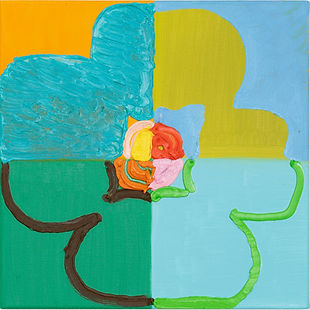
Judy Ledgerwood
Common Time #6
2023
16 x 16 x 2.5 in.
Oil on canvas

Judy Ledgerwood
Common Time #2
2023
16 x 16 x 2.5 in.
Oil on canvas

Judy Ledgerwood
Common Time #7
2023
16 x 16 x 2.5 in.
Oil on canvas

Mike Cloud
Portrait of a Adlai Stevenson
2022
20.5 x 19.5 x 2 in.
Acrylic on linen and stretcher bars


Mike Cloud
Israeli intersection Yona, Zefanya
48 x 41 x 4 in.
Oil, acrylic and mixed media on linen, canvas and stretcher bars

Barbara Jenkins
Johnny's gotta know when you're dead, lie down
2026
30 x 32 in.
Oil stick and water color on canvas,

Barbara Jenkins
9 to 5
2026
30 x 32 in.
Oil stick and water color on canvas,

Barbara Jenkins
Out of the Blue
2026
30 x 33 in.
Oil stick and water color on canvas

Barbara Jenkins
Dreamboat
2026
32 x 33 in.
Oil stick and water color on canvas,

Trey Rozelle
Stack of Blue Props #8
2025
66 x 46 x 22 in. as displayed, size variable
Oil on canvas

Jonathan Worcester
Untitled
2025
32 x 18.675 x 2 in.
Acrylic on canvas, artist frame


Jonathan Worcester
Untitled
2026
31.5 x 33.25 x 2.175 in.
Acrylic on panel

Jonathan Worcester
Untitled
2025
28.75 x 18 x 2 in.
Acrylic on panel

Michelle Grabner
Untitled
2026
16.5 x 12 x 1.5 in.
Milk paint on gypsum

Michelle Grabner
Untitled
2026
17 x 11 x 1 in.
Milk paint on gypsum

Michelle Grabner
Untitled
2026
12 x 16 x 1.25 in.
Milk paint on gypsum

Michelle Grabner
Untitled
2026
12 x 16 x 1 in.
Milk paint on gypsum

Michelle Grabner
Untitled
2026
11 x 17 x 1 in.
Milk paint on gypsum

Michelle Grabner
Untitled
2026
11 x 17 x 1 in.
Milk paint on gypsum

Michelle Grabner
Untitled
2026
16 x 12 x 1.5 in.
Milk paint on gypsum

600 - 1250

1250 - 2500

2500 - 4200

4200 - 7500

7500 - 11500

11,500 - 18000

18000 - 28000

28,000 +

POR

Unavailable